
A bunion is an abnormal, painful, bony bump that forms at the base of the big toe. The bunion is simply the lump on the side of the foot, while the underlying cause of the bunion is a minor deformity called Hallux Valgus. In Hallux Valgus, the bones that make up the large toe are at an angle rather than lying along a straight line.

Diagram of the Foot looking from above.
It shows a bunion as the bump that has formed at the base of the big toe. In addition, ‘hallux valgus’ is visible as the 1st metatarsal points out (away from the other bones), while the phalanx points in, causing first and second toes to touch. The X-ray also shows the sesamoid bones. These two tiny bones should sit almost right under the big toe’s foot bone.
Bunions & Hallux Valgus can occur for a number of reasons, but they are often associated with long-term use of inappropriate shoes. Regardless of footwear, there are a number of factors in the basic anatomy of the foot, including flatfeet or slightly loose joints, that make the development more likely.
The pain in the toe or along the bump can often be relieved with wearing correct or modified shoes. When this is inadequate, surgery can help by straightening the bones and removing the bunion. For more information, see Surgery for Hallux Valgus.
Symptoms
Bunions are very common. They can cause anything from trouble walking to trouble finding shoes that fit. In many cases, bunions and hallux valgus cause no problem at all.
The possible signs and symptoms of a bunion include:
- A bulging bump on the outside of the base of your big toe
- Swelling, redness or soreness around your big toe joint
- Thickening of the skin at the base of your big toe
- Corns or calluses, which develop where the first and second toes overlap
- Persistent or intermittent pain
- Restricted movement of your big toe
Pain from a bunion can range from mild to severe, often making it difficult to walk in normal shoes. The skin and deeper tissue around the bunion also may become swollen or inflamed.
The other toes can be affected by a bunion as a result of pressure from the big toe pushing inwards towards them. Toenails are more likely to become ingrown, or to irritate the other toes. Sometimes changes in your feet and the way you walk can result in the smaller toes becoming bent or claw-like (hammertoes), in particular the second toe.
When to see your doctor
Bunions often need no treatment. But see your doctor or a podiatrist (foot specialist) if you have:
- Persistent big toe or foot pain
- A visible bump on your big toe joint
- Decreased movement of your big toe or foot
- Difficulty finding shoes that fit properly
Causes
Hallux Valgus occurs when the normal balance of forces acting around the joints and tendons of the feet are disrupted. Over time the joint becomes loose. The foot bone behind the big toe slowly angles inwards, towards the other foot. The toe is then forced inwards, with a bump (the bunion) forming as the tendons and other tissues around the toe react to the abnormal position.
Interestingly, bunions can also occur on the joint of your little toe (bunionette).
Causes of this abnormal balance of forces resulting in bunions include:
- High-heeled, ill-fitting shoes or those with points (e.g. ballet)
- Inherited foot type
- Foot injuries
- Conditions that affect the shape of the feet including:
- Deformities present at birth including clubfoot and flatfeet
- Rheumatoid Arthritis
- Diabetes
- Arthritis
Any work or activity that puts extra stress on your feet can also be a cause of bunions.
Risk Factors
These factors may increase your risk of developing bunions:
- High heels. Wearing high heels forces your toes into the front of your shoes, often crowding your toes.
- Ill-fitting shoes. People who wear shoes that are too tight, too narrow or too pointed are also more susceptible.
- Arthritis. Arthritis may increase your risk through pain that changes the way you walk.
- Genetics & Heredity. Bunions often run in families, perhaps because of the shape of the foot.
Investigations
Your doctor can identify a bunion simply by examining your foot. During the exam, your doctor will ask you to move your big toe up and down to determine if your range of motion is limited. Your doctor will also look for signs of redness or swelling and asks you about pain.
After examining your foot, your doctor may take an X-ray to see the cause of the bunion and how bad it is.
Rarely, other tests may be ordered including:
- CT scan
- MRI
Your doctor will likely ask questions about the types of shoes you wear and how frequently you wear them. He or she may also ask if anyone in your family has had bunions or if you’ve had any injury to your foot.

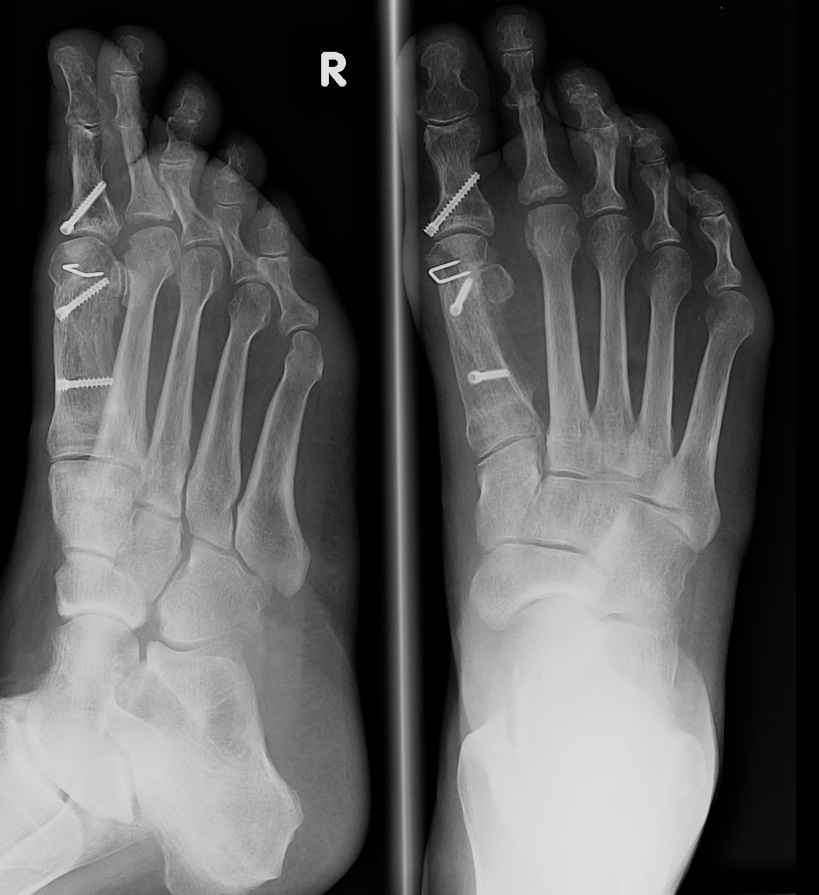
Above – X-ray of the normal Right Foot

This X-ray shows hallux valgus deformity & bunions in both feet, with a more exaggerated deformity on the right. Note the angle of the metatarsal bone – it should lie in a line as the other toes do.
Complications
Bunions may develop at any time, and though they don’t always cause problems, they’re permanent unless surgically corrected. If the small fluid sac (bursa) over the joint becomes swollen (bursitis), a bunion can be very painful and get in the way of daily life. Bunions do also have a tendency to grow with time, and may get larger and more painful, making soft wide shoes less effective at controlling symptoms.
Other complications can include:
- Skin changes like corns and calluses developing over the bump
- Changes in other toes, including hammertoe or clawing
Treatment
These tips may provide relief from a bunion:
- Apply a non-medicated bunion pad around the bony bump.
- If a bunion becomes inflamed or painful, apply an ice pack two to three times daily to help reduce swelling.
- Wear shoes with a wide and deep toe box.
- Avoid shoes with heels higher than 6 centimetres.
See your doctor if pain persists.
Treatment options vary depending on the severity of your bunion and the amount of pain it causes you. Early treatment is best to decrease your risk of developing joint deformities.
Conservative treatment
Non-surgical treatments that may relieve the pain and pressure of a bunion include:
- Changing shoes. Wear roomy, comfortable shoes that provide plenty of space for your toes.
- Padding and taping. Your doctor can help you tape and pad your foot in a normal position. This can reduce stress on the bunion and alleviate your pain.
- Medications. Paracetamol can control the pain of a bunion. Your doctor may suggest anti-inflammatory medicine, such as ibuprofen, to ease pain and swelling. Cortisone Steroid injections also can be helpful.
- Shoe inserts. Padded insoles (orthotics) may ease pain for a while, but there is no proof they stop a bunion getting worse. Arch supports from the chemist help some people. Others may need custom-made insoles.
Surgical options
If conservative treatment doesn’t provide relief from your symptoms, you may need surgery. There are many operations, and no one operation is best for everyone. Knowing what caused your bunion helps the surgeon choose the procedure most likely to correct it without it coming back. Most surgical procedures include a bunionectomy, which involves:
- Removing the swollen tissue from around your big toe joint
- Straightening your big toe by removing part of the bone
- Realignment of the metatarsal bone to reduce angular deformity
- Permanently joining the bones of your affected joint
After some operations you can walk on the foot straight away. After others, full recovery can take eight weeks or longer. To prevent a recurrence, you’ll need to wear proper shoes after recovery.
Surgery is not advised unless the bunion often hurts or gets in the way of daily life. Like any surgery, a bunionectomy has some risks. You may also still have pain or you could develop a new bunion in your big toe joint after surgery. Consider trying conservative treatment before having a bunionectomy.
Seeking Advice
Your Family Doctor (GP)
Your GP (family doctor) can find out what is wrong and help treat it. Your GP can
- tell you about your problem
- tell you the best ways to treat it
- give you medicine if you need it
- send you to a specialist if you need one
Your Podiatrist
A podiatrist is a foot specialist. They can often look after a bunion without any need for surgery.
A podiatrist can watch how you walk and see how weight passes through your foot. They can advise you on shoes, fit padding, and make or supply insoles. They can also treat the hard skin and corns that often come with a bunion.
They will also tell you if your bunion has reached the point where it is worth seeing a surgeon.
Prevention
To help prevent bunions, wear comfortable shoes that fit well:
- Be sure your shoes don’t cramp or irritate your toes.
- Choose shoes with a wide toe box. There should be space between the tip of your longest toe and the end of the shoe.
- Your shoes should conform to the shape of your feet without causing undue pressure.
More Information
More information and support services can be found at the following sites:
- Healthdirect – free Australian government health information and a nurse helpline
- Better Health Channel – Victorian government health information
- myDr – Australian health information written by doctors
- PEDro – a database of physiotherapy research
- Cochrane Library – plain-language summaries of medical research
Medical sources on First Metatarsal Fusion:
The latest research on first metatarsal joint fusion is accessible through the Cochrane Library and PubMed Database.
Does it work?
Does it work? Evidence for foot and ankle
What the research shows for foot and ankle treatments, including bunion surgery.
- Does shockwave therapy work for plantar fasciitis? Probably helps a little.
- Do insoles work for flat feet in children? Probably does not help.
- Do ankle braces prevent ankle sprains? Good evidence it helps.
- Do shoe inserts work for plantar fasciitis and heel pain? Probably does not help.
- Do PRP injections work for Achilles tendon pain? Probably does not help.
- Does bunion surgery work? Probably helps a little.
References
Robinson, A.H., Limbers, J.P., ‘Modern Concepts in the Treatment of Hallux Valgus’, Journal of Bone and Joint Surgery Britain, August 2005 Vol. 87-B, No. 8, pp. 1038–1045.
F.A.Q. | Frequently Asked Questions
Can I fix a bunion without surgery?
Not the bump itself, as a bunion is a change in the position of the bone and does not go back on its own. Wide soft shoes, padding and toe spacers do relieve pain for many people, and that is the aim of non surgical treatment.
Do toe straighteners or splints work?
They can ease pain and may slow the bunion in some people, but they do not straighten the toe permanently. There is no good evidence that they prevent the need for surgery.
When should I have surgery?
When the pain limits what you can do despite roomy shoes and padding. Surgery is not done to improve the look of the foot, because the recovery is long and results are better when pain is the reason.
How long is recovery after bunion surgery?
Most people walk in a stiff post operative shoe straight away and return to normal shoes at about 6 to 8 weeks. Swelling can last 6 months. Driving is usually possible once you are out of the surgical shoe and can brake firmly.
